博文

目前显示的是标签为“Maintenance”的博文

What are the Disadvantages of a Electromagnetic Flow Meter(EMF)?

图片
Electromagnetic Flow Meter(EMF), also known as magmeters, are widely used in various industries due to their ability to measure the flow of conductive fluids accurately. However, like any technology, they come with their own set of limitations. Understanding these disadvantages is crucial for industries to make informed decisions about their application. In this article, we will delve into the key drawbacks of magnetic flow meters, particularly focusing on their limitations in industrial settings.   1. Inability to Measure Non-Conductive Fluids  One of the most significant limitations of magnetic flow meters is their inability to measure non-conductive fluids accurately. Magnetic flow meters operate on the principle of electromagnetic induction, which requires the fluid being measured to be electrically conductive. When a conductive fluid flows through the magnetic field generated by the meter, it induces a voltage that is proportional to the flow rate. This voltage is the...

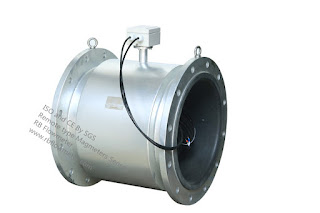
Electromagnetic Flowmeter Installation and Maintenance Guide

图片
In the industrial landscape, precise flow measurement is essential, and electromagnetic flowmeters play a crucial role. This guide will walk you through the installation and maintenance of these devices. I. Installation Preliminaries  Pipeline System Check - Ensure the pipeline is clean, devoid of any substances like welding slag, rust, or debris that could impede the flowmeter's operation. Post-installation, a thorough purge and clean, perhaps with compressed air or high-pressure water, is necessary.  Measure the pipeline's inner diameter precisely. The deviation from the flowmeter's nominal diameter should be within ±3%. If a mismatch exists, a reducer might be needed, with careful consideration for its position and impact on fluid flow.  Verify the compatibility of the pipeline material with the flowmeter's lining. For corrosive fluids, a suitable lining such as PTFE is often a good choice. Installation Environment Evaluation Use a magnetic field detector to scout fo...

Measuring Flow in Partially Filled Pipes: Magnetic vs. Ultrasonic Flow Meters

图片
Measuring Flow in Partially Filled Pipes: Magnetic vs. Ultrasonic Flow Meters When it comes to measuring flow in partially filled pipes, both magnetic (electromagnetic) and ultrasonic flow meters offer unique advantages and challenges. Understanding their operation principles and benefits can help in selecting the most suitable meter for specific applications. Magnetic Flow Meters: Principle:  They operate on Faraday's law of electromagnetic induction, where a magnetic field is applied across a pipe, and the voltage induced in the fluid is proportional to the flow rate  . Advantages: Provide highly accurate volumetric flow measurements. Have no moving parts, resulting in low maintenance and long-term stability. Can handle slurries and liquids with suspended solids. Ideal for applications requiring bidirectional flow measurement. Challenges in Partially Filled Pipes: May not be as accurate due to the non-uniform velocity profile near the pipe walls. Require full pipe flow for o...

What should I do if the flow meter is disturbed at the site of use?

图片
  In the fast-paced world of industrial production, flow meters serve as the backbone for accurate and reliable metering. However, like any sophisticated instrument, they are vulnerable to various environmental interference that can markedly impact their accuracy and stability. Addressing these challenges requires a multi-faceted approach: 1.  Protection Against Electromagnetic Interference Low-frequency Electromagnetic Interference:  Originating from power supplies like 220V, 50HZ AC, standard wiring practices that separate AC power lines from signal lines can significantly mitigate interference. Special attention should be paid to prevent crossing of cables in trays or protective tubes. High-frequency Electromagnetic Interference:  To minimize interference, flowmeter signal lines should not run parallel to high-power cables (e.g., 380V, 220V). Employing shielded wires can be a prudent measure. Effective Grounding:  Proper grounding of the flowmeter and associa...